Peptide storage and stability: what actually degrades product
Updated
In short
Store lyophilized peptides at -20°C protected from light, and reconstituted solutions at 2-8°C. In practice, most avoidable product loss comes from mechanical agitation and repeated freeze-thaw cycling rather than from storage temperature.
Storage conditions at a glance
| State | Temperature | Notes |
|---|---|---|
| Lyophilized, sealed | -20°C | Protect from light. Warm to room temperature before opening. |
| Lyophilized, short term | 2-8°C | Acceptable for weeks rather than months. |
| Reconstituted | 2-8°C | Validate working life for your own conditions. |
| Reconstituted, aliquoted | -20°C | Single-use aliquots avoid freeze-thaw cycling of the stock. |
The four things that actually degrade peptides
1. Mechanical agitation
Shaking is the leading cause of avoidable loss. Shear forces and the air-liquid interface created by vigorous mixing unfold the sequence. A vial swirled gently for a minute is in better condition than one shaken for five seconds.
2. Moisture
Lyophilized peptide is hygroscopic. Opening a vial straight out of the freezer draws condensation onto the cake and starts hydrolysis before any solvent is added. This is why the first instruction in every reconstitution protocol is to let the vial warm up.
3. Freeze-thaw cycling
Each cycle costs product. If a reconstituted stock will be drawn on repeatedly, split it into single-use aliquots at the outset — that converts many cycles on one vial into one cycle each on several.
4. Oxidation and pH
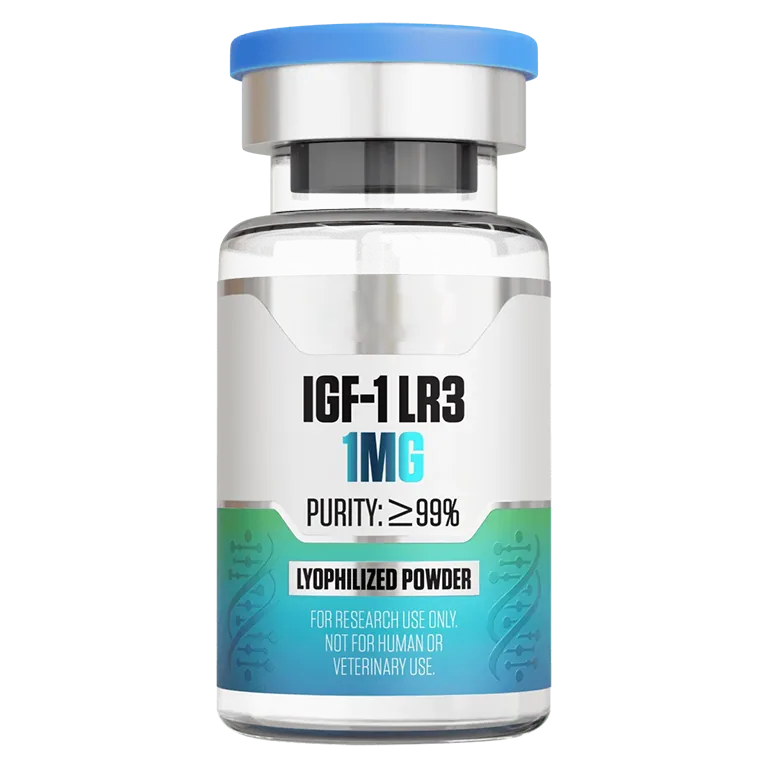
Sequences containing methionine, cysteine or tryptophan oxidise readily. Disulfide-bridged peptides are separately vulnerable to reducing conditions in a buffer. Recombinant proteins in the catalogue — IGF-1 LR3 at 83 residues, for instance — are more sensitive to all of this than short synthetic sequences.
Products with specific handling notes
Frequently asked questions
- At what temperature should lyophilized peptides be stored?
- -20°C, protected from light, in the sealed vial. Short-term storage at 2-8°C is acceptable for weeks rather than months.
- Does freezing reconstituted peptide damage it?
- A single freeze is generally tolerated; repeated freeze-thaw cycling is what costs product. Aliquot the stock into single-use volumes before freezing so each aliquot is thawed only once.
- How can I tell if a peptide has degraded?
- A correctly reconstituted solution is clear. Cloudiness, visible particulate or a solution that will not clear on gentle swirling all indicate a problem, and the nominal concentration can no longer be assumed. Analytical confirmation requires HPLC.
All products referenced are sold for research, laboratory, or analytical purposes only, and are not for human consumption.